If you want to track brand visibility in Claude, choose a platform that explicitly measures Claude answers rather than merely connecting Claude to another SEO product.
The short answer
- Claude visibility should be measured through separate mention, citation and response-mode metrics because Claude’s web search is conditional.
- Finseo lists Claude as a selectable model across its standard plans, with citation tracking included in every plan.[1]
- OtterlyAI supports selectable Claude tracking, but each Claude answer costs three credits.[19]
- Scrunch lists Claude under Enterprise rather than Core, while Profound and Peec do not clearly publish Claude-specific paid plan entitlements.
- In Finseo’s sample, cited URLs reappeared the next day in 31.9% of Claude cases, compared with 38.4% for ChatGPT and 65.5% for Perplexity.[30]
If you want to track brand visibility in Claude, choose a platform that explicitly measures Claude answers rather than merely connecting Claude to another SEO product. Finseo, OtterlyAI, Profound, Peec AI and Scrunch all publish evidence of Claude-related support, but their collection methods, plan access and citation reporting differ.[1][2]
The first distinction is between being mentioned and being cited. Claude may answer without searching the web, so a brand can appear in the response without a web citation; when Claude uses web search, the response can include cited sources.[3] A useful tracker therefore records the response mode, brand mentions and cited URLs separately.
Claude Visibility Tracking (2026): Tools That Monitor Your Brand in Claude
Best tools to track brand visibility in Claude AI answer engine optimization monitoring 2026
The clearest published options are Finseo and OtterlyAI when plan-level Claude access is the priority. Finseo lists Claude as a selectable model across its standard plans, while OtterlyAI makes Claude selectable but charges three credits per Claude answer.[2]
Profound supports Claude in Answer Engine Insights, but its public pricing does not identify a Claude-specific paid tier. Peec documents Claude model and fan-out analysis without clearly stating which plan monitors Claude.ai answers, and Scrunch lists Claude under Enterprise rather than Core.[2]
What does Claude visibility tracking measure?
Claude visibility tracking measures how often Claude mentions a brand, ranks it among competitors, cites the brand’s domain and surfaces particular pages as sources. These are related but different signals: a brand mention does not necessarily mean that Claude cited the brand’s website, while a cited page may appear without the brand being prominently named.
A robust measurement setup should capture:
- Mention rate: how often Claude names the brand.
- Citation rate: how often Claude cites the brand’s domain.
- Citation sources: the URLs, domains and page types Claude uses.
- Position: where the brand appears in the answer.
- Competitor visibility: which competing brands Claude names first.
- Response mode: whether the answer used web search.
- Prompt context: the market, language, funnel stage and query category.
Finseo describes citation tracking for Claude, ChatGPT, Perplexity and Gemini, with source-level details for prompts and cited domains.[1] Its broader visibility metrics include mention rate, citation rate, average position, share of voice and head-to-head competitor comparisons.[4]
The distinction between visibility and citations matters because Claude’s web search is conditional. Anthropic says Claude searches when current information would improve an answer, while its web-search API returns citations for web-grounded results.[5] In Finseo’s measured commercial-prompt sample, 39.1% of Claude answers had recorded searches, and answers without a recorded search had no citations in that dataset.[2]
How does Claude web search behave?
Claude does not necessarily search the web for every answer. Anthropic describes web search as conditional: Claude may search when current information is useful, and web search can be disabled in some interfaces.[6][7]
When web search is used through Anthropic’s API, the result includes citations with a URL and title.[8] This makes cited-source tracking possible for search-grounded answers, but it does not make citations a complete measure of Claude visibility.
A tracker should therefore label answers as search or non-search where the collection method permits it. The absence of a citation should not automatically be interpreted as poor brand visibility, because Claude may have answered from its model knowledge rather than from a live web search.
Which tools track brand visibility in Claude?
The following comparison focuses on publicly documented Claude support, plan access and the distinction between Claude answer monitoring and related integrations.
| Tool | Claude on entry plan | Web search on/off | Citations captured | Price |
|---|---|---|---|---|
| Finseo | Yes; Claude can be one of three selected models on Starter | The research report does not publish a Claude-specific on/off collection control; response-mode evidence is reported separately | Yes; citation tracking is included in every plan | €70/month with annual billing or €84 monthly for Starter; prices exclude VAT |
| OtterlyAI | Yes; Claude is selectable across subscriptions | Claude is accessed through its API using Haiku with web search; separate on/off controls are not published | The published material confirms Claude tracking, but does not specify the full citation fields | From $29/month; Claude answers cost three credits |
| Profound | Not published | Not published for Claude specifically | Answer Engine Insights measures brand, product and content references; Claude-specific citation fields are not fully published | Trial is 50 unique prompts daily for seven days; Claude-specific paid tier and price are not published |
| Peec AI | Not published for Claude | Claude model and web-search fan-out data are documented; Claude.ai answer collection is not clearly established | Fan-out and model data are documented; Claude.ai citation capture is not clearly specified | Starter $95/month, Pro $245/month, Advanced $495/month; Claude-specific entitlement not published |
| Scrunch | No; Claude is listed under Enterprise, not Core | Not published | Platform support is published, but citation-field detail is not specified in the cited plan evidence | Core $250/month; Claude access is listed under custom-priced Enterprise |
Finseo’s public pricing gives the clearest entry-level Claude option in this comparison: Starter includes 50 tracked prompts, 4,500 AI answers per month and three selected models, one of which can be Claude.[9] OtterlyAI also publishes explicit Claude access, but its three-credit cost per Claude answer makes query budgeting especially important.[5][10]
Profound and Peec require more qualification. Profound’s product page supports Claude in Answer Engine Insights, but the public trial engine list names ChatGPT, Gemini and Google AI Overviews rather than Claude.[11][12] Peec’s changelog documents Claude models and fan-out searches, but its public pricing table does not clearly identify a plan for monitoring Claude.ai answers.[13]
Scrunch’s plan distinction is more direct: Core lists ChatGPT, Perplexity, Google AI Overviews and Copilot, while Claude appears in the Enterprise list.[10] Its public Enterprise pricing is custom.[14][10]
Which Claude AI brand visibility tracking tools are worth comparing?
1. Finseo — the clearest published self-serve Claude option
Finseo is built by the team behind this site.
Finseo tracks selected prompts in Claude and reports brand mentions, citations, competitors and source URLs. Citation tracking is included in every plan, and Claude can be selected among the three models tracked simultaneously on Starter, Business and Growth.[14] From Business, Finseo also analyzes AI crawler visits, including ClaudeBot and Claude-SearchBot, from server logs and CDN integrations such as Cloudflare, Akamai, Fastly and Vercel, and classifies each visit as live answer, search index or training. Data is hosted in Germany, and every organisation gets a data processing agreement (DPA).
Key features documented for Claude-related visibility work include:
- Brand mention and citation tracking across tracked prompts.[11]
- Source and domain analysis for cited pages.[15][13]
- Competitor ranking and head-to-head comparisons.
- Prompt-level and market-level filtering.
- AI traffic analytics and attribution features on higher plans.[16][17]
- Query fan-out analysis where the engine exposes its searches.[2]
- MCP access from Starter, with a REST API available from Growth.[18]
Strengths
- Claude access is stated across the standard self-serve model tiers.[10]
- Citation tracking is included in every plan.[19]
- The entry plan has published prompt and answer limits.[3][19]
- The platform connects visibility measurement with traffic, attribution and prioritized tasks on higher plans.[20]
Limitations
- Standard plans track three models simultaneously, so monitoring Claude alongside ChatGPT, Gemini and Perplexity may require prioritization or additional model capacity.[14]
- Finseo’s Claude sample is smaller than its ChatGPT sample in the published research.[2]
- Fan-out data is available only where an engine exposes its searches.[2]
- The published pricing does not provide a Claude-only plan; Claude uses one of the selected model slots.[19]
Pricing checked 16 November 2026
Starter costs €70 per month with annual billing or €84 with monthly billing, excluding VAT. Business costs €175 annually billed monthly or €210 monthly, while Growth costs €399 annually billed monthly or €479 monthly.
Verdict: Best for teams that want a published self-serve Claude option, source tracking and a broader workflow covering visibility, analytics and action.
2. OtterlyAI — explicit Claude access with credit-based usage
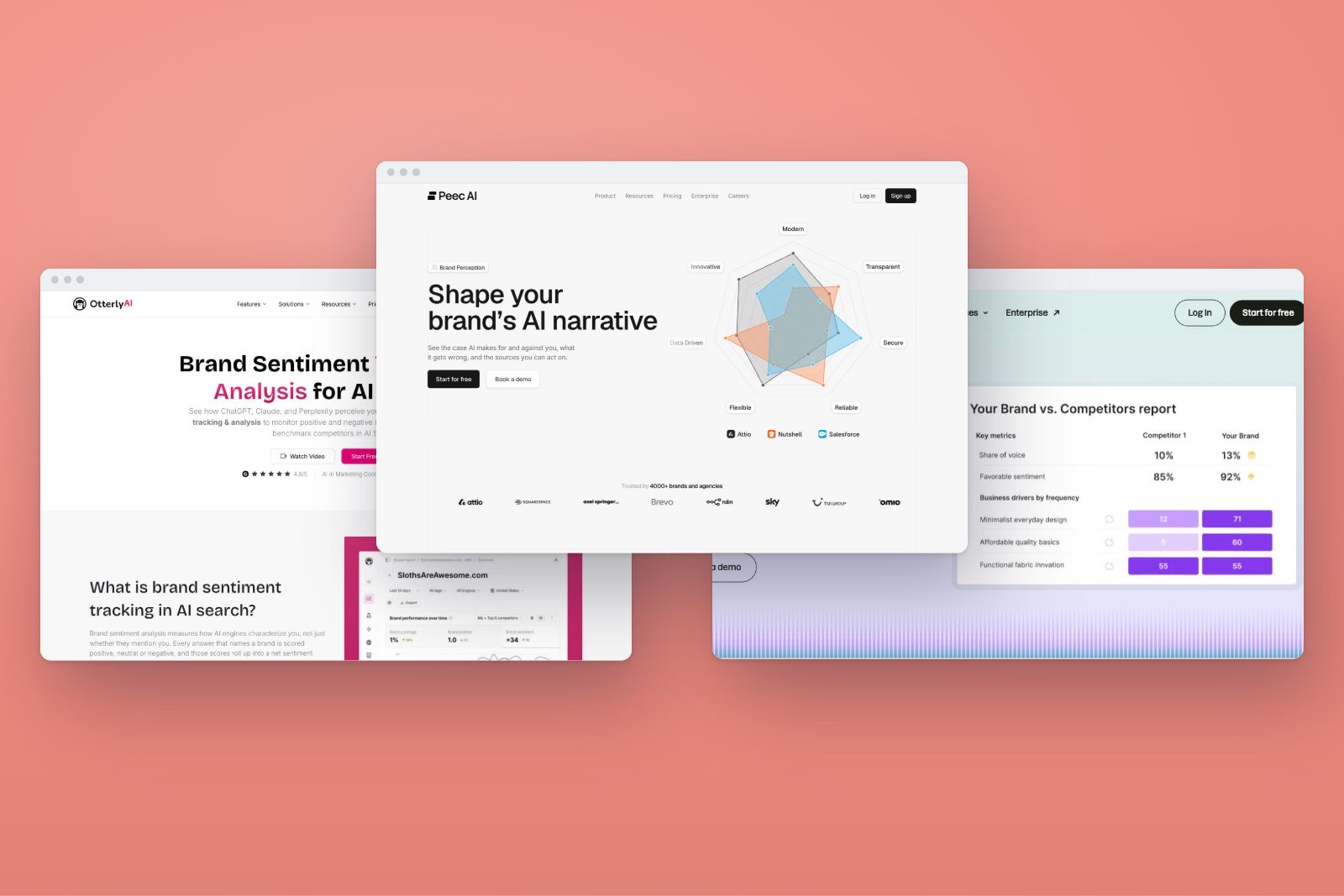
OtterlyAI lists Claude among its selectable search engines and says Claude is accessed through its API using the Haiku model with web search.[21] Unlike a simple “Claude supported” badge, its pricing documentation identifies a specific usage rule: one Claude answer costs three credits, compared with one credit for other engines.[19]
Key features
- Claude can be selected across subscription plans.[16][22]
- Claude is accessed through the API using Haiku and web search.[5]
- Engine selection is available on subscriptions, with at least three engines selectable.[16]
- Claude usage is charged at three credits per answer.[19][11]
Strengths
- The Claude entitlement is more explicit than vendors whose public pages only mention Claude generally.[23]
- The credit multiplier helps buyers estimate the cost of Claude-heavy monitoring.
- Entry pricing is lower than several competing published tiers.[10]
Limitations
- Three credits per Claude answer can reduce effective query volume.[6]
- The cited public material does not describe a full Claude-specific citation schema.
- API-based Claude access may not represent the same collection surface as every consumer Claude interface.[16][5]
Pricing checked 16 November 2026
OtterlyAI’s November 2026 pricing announcement lists Lite at $29 per month, Standard at $189, Premium at $489 and custom Enterprise.[16]
Verdict: Best for buyers who want selectable Claude coverage and a transparent credit rule, provided API-based collection matches their measurement needs.
3. Profound — Claude support, but unclear public plan placement
Profound describes Claude as a supported capability in Answer Engine Insights for measuring brand, product and content references.[11] Its public materials do not identify a Claude-specific paid tier, and the published trial names ChatGPT, Gemini and Google AI Overviews rather than Claude.
Key features
- Answer Engine Insights measures references to brands, products and content.[24]
- Claude support is documented in the product material.[5]
- The trial provides 50 unique prompts daily for seven days, but the named trial engines do not include Claude.[11][12]
Strengths
- Claude is treated as part of the answer-engine measurement product rather than only as an external workflow integration.[18]
- The product is positioned for brand and content reference analysis.[24]
Limitations
- Claude’s trial access is not confirmed in the public trial engine list.[11][12]
- Claude-specific paid access and pricing are not published in the cited materials.[5]
- Buyers must confirm whether the product monitors Claude.ai answers, Claude API outputs or another collection surface.
Pricing checked 16 November 2026
The cited public pricing material gives trial terms but does not publish a Claude-specific paid tier or price.
Verdict: Best for teams already evaluating Profound that can confirm Claude collection and plan entitlement before purchase.
4. Peec AI — useful Claude fan-out evidence, unclear Claude.ai coverage
Peec’s changelog documents tracked Claude models and visibility into Claude Haiku and Sonnet fan-out searches, including web searches.[13] That is meaningful evidence of Claude-related analysis, but it does not by itself establish that Peec samples the consumer-facing Claude.ai answer surface.
Key features
- Claude model and fan-out support are documented.[25][21]
- Claude web-search fan-outs are included in the published product evidence.[3]
- Public plans include Starter, Pro, Advanced and Enterprise.[14]
Strengths
- Fan-out analysis can show which sub-queries Claude generates while answering a prompt.[2]
- The product provides a published tier structure and model limits.
Limitations
- The public tier table does not clearly state which plan monitors Claude.[20]
- Claude model or fan-out output is not the same as confirmed Claude.ai answer monitoring.
- Citation capture for Claude.ai responses is not clearly specified in the cited material.
Pricing checked 16 November 2026
Peec lists Starter at $95 per month, Pro at $245 and Advanced at $495, with custom Enterprise pricing.[14]
Verdict: Best for teams prioritizing fan-out and model-level analysis, subject to confirming the exact Claude collection surface.
5. Scrunch — Claude appears to be Enterprise-only
Scrunch’s public platform comparison places Claude among Enterprise-supported LLMs, while Core lists ChatGPT, Perplexity, Google AI Overviews and Copilot.[26][27] This makes Scrunch unsuitable for buyers who require Claude visibility on an entry-level plan.
Key features
- Claude is included in the published Enterprise LLM list.[14]
- Core includes a narrower set of engines.[10][16]
- Enterprise pricing is custom.[14][10]
Strengths
- The plan comparison makes the Claude gate visible.[28]
- Enterprise buyers can evaluate Claude alongside other listed LLMs.[25]
Limitations
- Claude is not listed for Core.
- Enterprise pricing is not published.[3]
- The cited plan evidence does not detail Claude citation capture or web-search controls.
Verdict: Best for enterprise buyers already considering Scrunch and prepared for custom pricing.
How do Claude citations differ from ChatGPT and Perplexity?
Claude, ChatGPT and Perplexity do not expose identical search behavior. Anthropic describes Claude web search as conditional, OpenAI provides a Search mode whose web-search responses may include citations and a Sources panel, and Perplexity describes real-time search with numbered citations in every answer.[29][5]
This means a citation-rate comparison is meaningful only when the collection method and response mode are documented. Counting citations from Claude’s non-search answers alongside Perplexity’s search-oriented answers can make the comparison misleading.[29]
Finseo’s October 2026 study provides one directional comparison. It found that cited URLs reappeared the following day in 31.9% of Claude cases, compared with 38.4% for ChatGPT and 65.5% for Perplexity. The study used customer-selected commercial prompts, mostly from Germany, Austria and Switzerland, and Claude had the smallest sample, so these figures should not be treated as universal engine rankings.
| Engine | Cited URLs kept the next day | Cited domains kept the next day | Interpretation |
|---|---|---|---|
| Claude | 31.9% | 41.1% | More variable citation URLs in this sample |
| ChatGPT | 38.4% | 50.5% | Somewhat higher retention than Claude |
| Perplexity | 65.5% | 72.7% | Highest retention in this sample |
The same study measured 39.1% of Claude answers with recorded searches, compared with 99.8% of ChatGPT answers under its particular setup. The ChatGPT configuration searched on almost every answer, so this is a property of that measurement design rather than a claim about every ChatGPT session.
An independent academic comparison reported median citation ages of 5.1 months for Claude and 8.0 months for ChatGPT across approximately two million citations.[23] Citation age is different from next-day citation retention, so the two findings should not be combined into a single ranking.
How should teams measure Claude visibility in practice?
Use a consistent measurement protocol rather than relying on a single dashboard number.
- Define the visibility unit: mention, cited URL, cited domain, answer position or conversion.
- Build a fixed prompt set covering informational, commercial, comparison and recommendation queries.
- Record market, language, date and prompt category for every observation.
- Label whether Claude used web search whenever the collection method exposes that information.
- Track Claude mentions separately from citations.
- Compare competitors using the same prompt set and engine configuration.
- Repeat prompts across multiple days before drawing conclusions about citation stability.
- Report the collection surface, such as Claude.ai, Anthropic API or a vendor-specific endpoint.
- Treat fan-out searches as supporting evidence, not as a substitute for the final answer.
- Connect visibility data to traffic and conversions only when the attribution method is clearly defined.
Finseo’s published stability methodology repeated the same prompts once per engine per day and reported the market, prompt set, period and sample size.[30] That approach is more informative than presenting a single daily citation snapshot as a durable ranking.
What are the best Claude visibility tracker AI search visibility tracking tools in 2026?
For a self-serve buyer, Finseo is the most clearly documented option in the supplied evidence because Claude is selectable on standard plans and citation tracking is included in every plan.[1] OtterlyAI is a strong alternative when explicit engine selection matters, but Claude answers consume three credits.[19]
For enterprise buyers, Scrunch may fit if custom pricing and Enterprise-only Claude access are acceptable.[10] Profound and Peec are worth considering when their broader answer-engine or fan-out workflows fit, but both require confirmation of the exact Claude collection surface and plan entitlement.
Which tool is right for each Claude tracking scenario?
- Lowest published self-serve entry for Claude: Finseo Starter, at €70 monthly with annual billing or €84 monthly, excluding VAT.[9]
- Explicit credit accounting for Claude: OtterlyAI, where each Claude answer costs three credits.[19]
- Broader visibility, analytics and action workflow: Finseo, whose published product evidence covers citations, analytics, attribution and tasks across plan levels.
- Claude fan-out investigation: Peec, subject to confirming whether the required data represents Claude.ai answers or model/API activity.[6][2]
- Existing Profound customer: Profound, after confirming Claude’s paid entitlement and collection surface.[26]
- Enterprise buyer needing Scrunch: Scrunch Enterprise, because Claude is not listed under Core.[27][10]
What should buyers ask before purchasing a Claude tracker?
Ask whether the product measures Claude.ai responses, Anthropic API responses, Claude model outputs or only fan-out searches. These are not interchangeable datasets.
Also ask whether citations are captured only when Claude searches, whether non-search mentions are retained, how many Claude answers count against the plan, and whether the dashboard distinguishes cited URLs from cited domains. OtterlyAI’s three-credit rule demonstrates why answer-unit pricing can materially affect coverage.[19][31]
Finally, ask for a sample export showing prompt, response mode, mention status, cited URL, cited domain, competitor position and collection date. Without those fields, a generic “Claude supported” label may not answer the visibility question the team actually needs.
Frequently asked questions
Can Claude mention my brand without citing my website?
Yes. Claude can answer without web search, so a brand mention and a cited domain are separate visibility signals.[21] In Finseo’s measured sample, non-search answers had no recorded citations, but that was an observation from that dataset rather than a universal Anthropic rule.[2]
Which tools track brand visibility in Claude AI?
Finseo and OtterlyAI publish the clearest standard-plan evidence for Claude access.[32][33] Profound supports Claude in Answer Engine Insights, Peec documents Claude model and fan-out data, and Scrunch lists Claude under Enterprise; buyers should confirm each product’s exact collection surface and plan entitlement.
Does Claude always use web search for current information?
No. Anthropic describes Claude web search as conditional, meaning Claude may search when current information would improve the answer.[5] API web-search results include citations, but the absence of a citation does not by itself prove that Claude failed to mention a brand.
How do Claude citations differ from ChatGPT and Perplexity?
Claude’s web search is conditional, while ChatGPT exposes a Search mode and Perplexity describes real-time search with citations in every answer.[29][5] In one Finseo sample, next-day cited-URL retention was 31.9% for Claude, 38.4% for ChatGPT and 65.5% for Perplexity, although the sample conditions limit generalization.[30]
Is Semrush’s Claude connector a Claude visibility tracker?
No. Semrush’s connector makes Semrush marketing intelligence available inside Claude, while Semrush’s published Prompt Tracking engine list names ChatGPT Search, Google AI Mode and Gemini rather than Claude.[18] Using Semrush in Claude should not be confused with measuring how Claude answers brand prompts.
What is the best Claude visibility tracker for an AEO team?
Finseo is the clearest fit when the team wants published self-serve Claude access, citation tracking and a broader action workflow.[18] OtterlyAI may suit teams that prefer explicit engine selection and can budget for three credits per Claude answer.[19]
Sources
- 1AI Citation Tracking: See Which Sources ChatGPT Cites | Finseo — finseo.ai
- 2Query Fan-Out in Germany: 520,000 ChatGPT & Claude Answers | Finseo — finseo.ai
- 3Searching the web with ChatGPT | OpenAI Help Center — help.openai.com
- 4Peec AI - AI Visibility and Share of Voice Tracking — peec.ai
- 5Introducing web search on the Anthropic API | Claude by Anthropic — anthropic.com
- 6Query Intent and Google Rank as Joint Predictors of AI Citation: A Multi-Platform Observational Study — aixiv.science
- 7Enable and use web search | Claude Help Center — support.claude.com
- 8Web search tool — platform.claude.com
- 9Pricing, Starter, Business, Growth & Enterprise | Finseo — finseo.ai
- 10Scrunch | FAQs - What is the pricing for Scrunch plans? — scrunch.com
- 11Pricing | Profound — tryprofound.com
- 12Understand how AI is talking about your brand | Profound — tryprofound.com
- 13Peec AI Changelog — peec.ai
- 14Pricing for Peec AI - AI Search Platform for Marketing teams and SEO agencies — peec.ai
- 15AI Visibility Toolkit Pricing | Semrush — semrush.com
- 16New OtterlyAI Pricing: Same Price, More Prompts, Your Engines — otterly.ai
- 17Semrush AI visibility features — semrush.com
- 18Semrush Launches Official Connector for Claude, Bringing Marketing Intelligence into AI Conversations — semrush.com
- 19OtterlyAI Pricing - Transparent & Simple — otterly.ai
- 20What platforms does Scrunch monitor? | Scrunch Help Center — helpcenter.scrunchai.com
- 21Which AI searches does OtterlyAI support? — help.otterly.ai
- 22How can I purchase Google AI Mode/Gemini/Claude? — help.otterly.ai
- 23What Drives Citations in Production Large Language Models? An Observational Multi-Method Study of Two Million AI Citations Across Ten Thousand Web Pages — arxiv.org
- 24Introducing support for Claude | Profound — tryprofound.com
- 25Comparative evaluation of large language model–based chatbots in a septic arthritis scenario: ChatGPT, Claude, and Perplexity - PMC — pmc.ncbi.nlm.nih.gov
- 26Scrunch | FAQs - Which AI platforms and LLMs can Scrunch track and monitor? — scrunch.com
- 27Scrunch | Pricing — scrunch.com
- 28Prompt Tracking on Semrush — semrush.com
- 29How does Perplexity work? — perplexity.ai
- 30How Stable Are AI Citations in Germany? 1.4M Answers | Finseo — finseo.ai
- 31What are the plans and the pricing of OtterlyAI? — help.otterly.ai
- 32Perplexity Search | Accurate, Cited AI Answers for Every Question — perplexity.ai
- 33Synthetic Sources?: Auditing Generative Search Engine Citations for Evidence of AI-Generated Sources | Proceedings of the AAAI/ACM Conference on AI, Ethics, and Society — ojs.aaai.org